
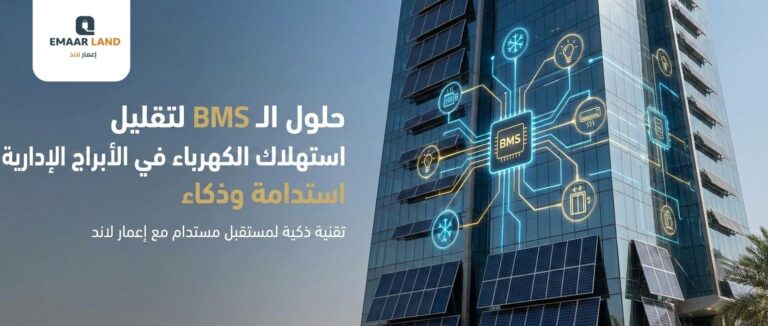
Office towers in our major cities such as Riyadh, Jeddah, and Dammam are considered vibrant economic hubs, yet at the same time they are classified as the largest consumers of electrical energy in the Kingdom of Saudi Arabia. With the launch of sustainability programs within Saudi Vision 2030, and the private sector's move toward reducing operational expenses (OPEX), the urgent need for a technology that intelligently manages this massive consumption has emerged.
This is where the role of BMS (Building Management System) or what is known as the building management system comes in. It is the “central brain” that does not merely monitor what happens inside the tower, but makes real-time decisions to reduce waste and improve equipment efficiency. At Emaar Land General Contracting Company, we take pride in providing integrated BMS solutions that transform traditional office towers into smart buildings that save up to 30% of the annual electricity bill.
Where Does the Electricity Go in Office Towers?
To understand the importance of BMS System, we must first know where energy is consumed. Engineering studies in the Saudi market indicate that electricity consumption distribution in office towers often follows this pattern:
- HVAC (Heating, Ventilation and Air Conditioning): Consumes approximately 60% to 70% of total energy, especially during the long summer months.
- Lighting: Consumes around 15% to 20%.
- Elevators, pumps and other systems: Consumes the 10% remaining.
The BMS targets these specific points to perform “smart energy optimization” without compromising employee comfort or work efficiency.
How does a BMS reduce electricity consumption? (Technical Solutions)
The system operates through a network of sensors and actuators connected to a central control unit. Here are the key solutions we implement in Emaar Land:
1. Smart HVAC Control (HVAC Optimization)
Instead of running air conditioners at full capacity all day, the system:
- Adjusts temperature based on occupancy: Sensors detect when there are no employees in a meeting room or a specific office, and then raise the temperature or shut off the air conditioning completely.
- Demand-Controlled Ventilation (DCV): Monitors carbon dioxide ($CO_2$) levels and supplies fresh air only when needed, reducing the load on fans and chillers.
2. Smart Lighting Control (Lighting Control)
- Daylight Harvesting: Sensors measure the light intensity coming through windows and automatically dim indoor lighting to maintain a constant light level with minimal energy consumption.
- Motion Sensors: Lights in corridors, restrooms, and warehouses are switched off as soon as they become vacant.
3. Predictive Motor Maintenance (VFD Control)
Variable frequency drives ($VFD$) connected to the BMS control the speed of pump and fan motors. Instead of running at 100% speed at all times, the motor operates only at the speed required for the current load, saving significant energy and extending equipment life.
By the Numbers: Calculating Financial Savings and Return on Investment (ROI)
Investing in BMS System is one of the smartest financial decisions. Suppose an administrative tower's annual electricity consumption is E_{total}, and the savings percentage achieved by the system is R_{saving}. We can calculate the annual savings (S) using the formula:

Based on our projects, if a tower pays one million riyals annually for electricity, the BMS system saves approximately 250,000 to 300,000 riyals annually. This means the system recovers its full cost (Payback Period) within 2 to 3 years only, after which the savings become “net profit” for the facility.
Comparison table: Traditional tower vs. tower managed with a BMS
| Comparison aspect | Traditional tower | Tower with BMS (Emaar Land) |
| Electricity consumption | Very high (fixed) | Low (flexible according to need) |
| Air conditioning and ventilation | Operates on a manual timetable | Operates with occupancy and $CO_2$ sensors |
| lighting | Depends on staff awareness | Fully automated (based on light and movement) |
| Equipment lifespan | Short due to continuous operation | Long thanks to predictive maintenance |
| Fault management | Detected only after the fault occurs | Instant alerts before a malfunction occurs |
| Sustainability | Does not comply with LEED standards | Complies with and supports the “Green Building” certification” |
BMS integration with other low-voltage systems
In Emaar Land General Contracting, we stand out for our ability to make the building “think” as a single entity. Our BMS system is connected to:
- Surveillance cameras and artificial intelligence: Using camera data to determine the number of people in a specific area and adjust air conditioning accordingly.
- Access control systems: As soon as an employee checks in with facial recognition, the air conditioning and lighting in their office are automatically activated.
- Fire systems: To open all emergency exits and stop elevators and fans to prevent the spread of smoke as soon as a fire is detected.
Why choose Emaar Land to implement a BMS system in your tower?
Foundation BMS System It requires engineering expertise in electrical systems, mechanics, and programming. Choosing us guarantees you:
- Custom design: There is no ready-made BMS system; we design the system based on your tower's engineering and load distribution.
- Easy-to-use user interface (Dashboard): We provide the building manager with a simple control panel on mobile or laptop that displays real-time consumption and any faults on every floor.
- Top global brands: We work with leading control systems manufacturers such as (Schneider Electric, Honeywell, Siemens) to ensure the quality of sensors and control units.
- Compliance with the Saudi Code: We ensure that all systems comply with the requirements of the Saudi Building Code and energy conservation.
Frequently Asked Questions About BMS Systems (FAQ)
Can a BMS system be installed in an existing tower (Old Building)?
Yes, at Emaar Land we offer “Smart Retrofitting” (Retrofitting) solutions, where we add sensors and control units to existing equipment and convert it into a smart system without the need to replace chillers or elevators entirely.
Does the BMS system require a fast internet connection?
The system operates internally over a stable Local Network. Internet is only needed if you wish to monitor and manage the tower remotely or store reports in the Cloud.
How long does implementation take for a medium-sized office tower?
The duration depends on the number of points to be controlled, but on average the project takes 3 to 6 months, including design, supply, programming, and testing.
Conclusion: Investing in intelligence is the peak of savings
BMS solutions BMS They are not merely a technical addition, but a courageous managerial decision that places your facility among the world's sustainable towers. In 2026, wasting energy in empty buildings is no longer acceptable, and artificial intelligence is the optimal tool for achieving a balance between comfort and conservation.
We at Emaar Land, we are ready to be your partner on the journey of transformation toward green and smart buildings.
Would you like a preliminary study of the expected savings percentage in your office tower?
Contact our engineering team now, and let us start together designing a more intelligent and sustainable future for your project.
📞 For inquiries and contact: Click here
🌐 Our website: https://emaar.sa/
📍 Headquarters: Riyadh – and we serve all major real estate projects in the Kingdom.